





Evidence-Based Programs → Family Healthy Weight Programs
Family Healthy Weight Programs
This page provides an overview of family healthy weight programs (FHWPs), barriers to sustainability, and strategies to support program coverage.
- Introduction to Family Healthy Weight Programs
- Considerations for Family Healthy Weight Program Sustainability
- Coverage Strategies for Family Healthy Weight Programs
- Resources
Introduction to Family Healthy Weight Programs
In response to high prevalence of childhood obesity, interest in evidence-based, family-centered childhood obesity initiatives has grown. These programs are important because they are designed to address the unique needs of children, increase healthy habits, and reduce the risk of obesity-related conditions, including type 2 diabetes.
FHWPs are unique in that they actively engage both children and family members in developing healthy eating and physical activity behaviors. By focusing on the sensitive topic of weight and encouraging a supportive family context, FHWPs help parents and caregivers implement practical, sustainable lifestyle changes that may benefit the entire household.
What is a Family Healthy Weight Program?
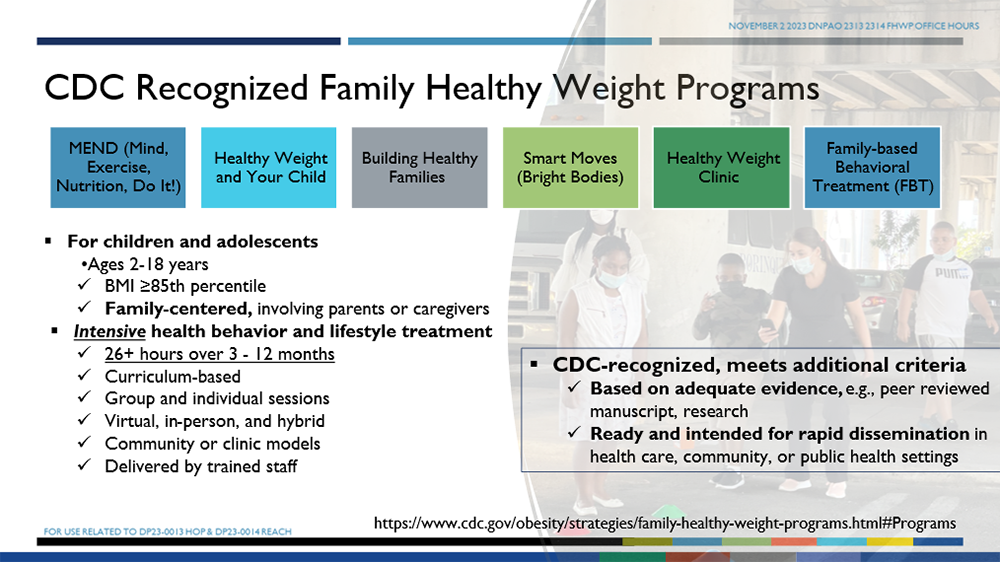
FWHPs are comprehensive, family-based lifestyle interventions designed to help children with overweight or obesity progress towards healthier weight through positive behavior change. FHWPs are supported by recommendations from several national organizations including the U.S. Preventive Services Task Force (USPSTF), the American Psychological Association (APA), and the American Academy of Pediatrics (AAP).
FHWPs follow the foundational principles of intensive health behavioral and lifestyle treatment (IHBLT). CDC-recognized FHWPs include programs that have demonstrated sufficient evidence, are appropriate for children with obesity, and are ready for implementation.
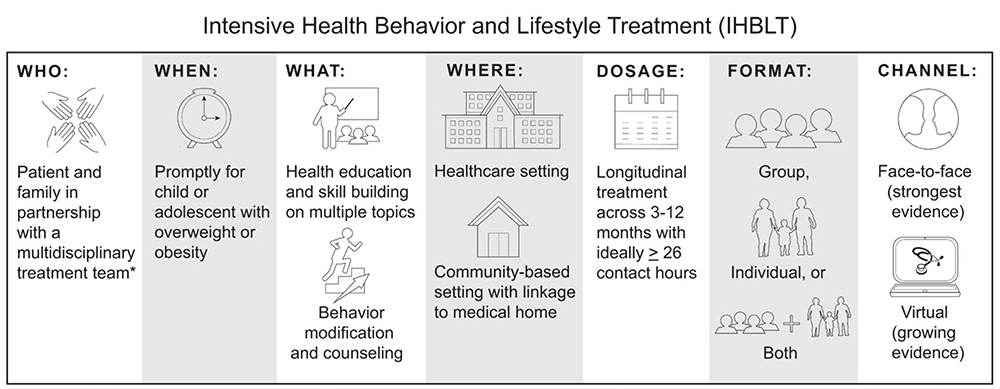
Source: American Academy of Pediatrics. Clinical Practice Guidelines for the Evaluation and Treatment of Children and Adolescents With Obesity. Pediatrics. 2023;151(2). doi:10.1542/peds.2022-060640
CDC Recognized FHWPs include:
- Mind, Exercise, Nutrition…Do It! (MEND)
- Healthy Weight and Your Child
- Building Healthy Families
- Smart Moves for Kids (Bright Bodies)
- Healthy Weight Clinic
- Family-Based Behavioral Treatment (FBT)
- Fit Together
- JOIN for ME
Evidence Supporting Family Healthy Weight Program
At a high level, FHWPs help reduce or stabilize a child’s weight and body mass index (BMI). Additional benefits for participants include improved lifestyle behaviors (e.g., nutrition and physical activity), increased self-esteem and self-efficacy, and improvements in metabolic health indicators such as blood pressure and lipids.
Parents and caregivers may also benefit from participation, including weight loss, reduced stress, and improvements in self-efficacy and quality of life. Resources supporting the evidence base for FHWPs are provided at the bottom of this page.
Considerations for Family Healthy Weight Program Sustainability
Despite their demonstrated benefits, FHWPs often face sustainability challenges. Program costs frequently exceed available reimbursement, leading many organizations to rely on grants, braided funding, or other supplemental funding sources. For participants, out-of-pocket program costs may also serve as a barrier to enrollment and retention when services are not otherwise subsidized or covered by insurance. These challenges underscore the importance of developing sustainable financing and coverage pathways to support long-term program availability.
Additional barriers to access to FHWPs include:
- Program availability in communities and clinics
- Health care provider awareness of FHWPs
- Insufficient referral systems
- Bias and stigma toward overweight and obesity
- Participation barriers such as transportation and childcare
One promising practice to build the capacity and infrastructure for claims-based reimbursement is forming an umbrella hub arrangement (UHA). UHAs create strategic partnerships between community-based organizations and health care payment systems to provide administrative support, coordinate services, and facilitate reimbursement. For example, the YMCA of Metropolitan Milwaukee partnered with state of Wisconsin Chronic Disease Division and the CDC to establish an umbrella hub organization (UHO). The UHO will include a Health Benefits Network that will create an insurance reimbursement model for YMCA Evidence-Based Health Interventions, including Healthy Weight and Your Child, a FHWP. Ongoing work is needed to establish it as a covered benefit with contracted payors.
Coverage Strategies for Family Healthy Weight Programs
Coverage strategies are increasingly being explored to support the long-term financial sustainability of FHWPs beyond start-up funding and grant support. The following payment approaches may help sustain FHWPs and are similar to financing mechanisms used for the National DPP lifestyle change program and diabetes self-management education and support (DSMES) services.
- State plan amendment (SPA): An approved SPA allows states to make permanent changes to their Medicaid programs, such as adding new provider types, expanding eligible populations, or modifying covered benefits. For example, Missouri Medicaid (MO HealthNet) used a SPA to establish coverage for biopsychosocial treatment of obesity for children, adolescents and adults, including medical nutrition therapy and behavioral health counseling designed to support weight management and behavior change. Under this benefit, youth participants receive multi-component family-based behavioral treatment interventions that engage both the parent/guardian/caregiver and the child or adolescent. For more information on SPAs see the Attaining Coverage Through Medicaid State Plan page of the Coverage Toolkit.
- Section 1115 demonstration waivers: Once approved by CMS, these waivers allow states to pilot innovative services or approaches to deliver Medicaid benefits. With this option, Medicaid could create a FHWP benefit and allow it to be included under an 1115 waiver. For more information on section 1115 demonstration waivers, see the Attaining Coverage through a Section 1115 Demonstration Waiver page of the Coverage Toolkit.
- In lieu of services and settings (ILOS) under managed care: Under ILOS authority, Medicaid managed care plans may offer FHWPs as cost-effective, medically appropriate alternatives to traditional Medicaid-covered services. For example, instead of receiving obesity-related counseling solely through physician visits and nutrition services in a clinical setting, eligible individuals may participate in an FHWP delivered in a community-based setting. One example of this approach is the Oregon Health Authority (Oregon Medicaid), which has ILOS authority to cover services in alternative settings as an option for reimbursement, including community health worker services, the National DPP lifestyle change program, DSMES services, and chronic disease self-management education programs.
- Value-added services: Medicaid managed care organizations (MCOs) or other similar entities can offer additional services beyond those included in state Medicaid contracts. These “value-added services” provide another potential pathway to integrate FHWPs into Medicaid managed care. Through this approach, MCOs can voluntarily offer FHWP services that are not otherwise included in state Medicaid benefits. For example, the YMCA of the Triangle partnered with Blue Cross Blue Shield of North Carolina for a three-year, value-based community integrated health pilot. The program bundled health coaching, YMCA membership, and participation in evidence-based program interventions, including FHWP, to support health outcomes.
- Traditional health care billing: While no single code currently exists to cover the full range of services provided through a FHWP, providers may use multiple billing codes to reimburse individual program components–a practice often referred to as “cobbling” codes. This approach typically requires an established billing infrastructure, qualified billing providers, and delivery within a clinical setting. For example, Blue Cross and Blue Shield of Louisiana developed a childhood obesity benefit for children at high risk for obesity-related health conditions. Services are delivered by a multi-disciplinary team and reimbursed through existing billing mechanisms that support nutrition, behavioral health, and clinical services.
- Invoice billing: Invoice billing offers a relatively simple reimbursement approach in which the implementing organization contracts directly with the state Medicaid agency, MCO, or commercial insurer. Unlike traditional health care billing, this model does not require billing codes or specialized billing staff. Under this approach, an agreement may establish a fixed payment rate for delivering an FHWP to a specified number of children for a specific length of time. The invoice report may document the number of children over a defined period. Invoice submissions may include information on program participation and aggregate outcome measures to demonstrate program impact. The YMCA’s Healthy Weight and Your Child program has had some success with this method.
Family Healthy Weight Program Resources
- Evidence
- Evidence review for AAP’s 2023 Clinical Practice Guideline for the Evaluation and Treatment of Children and Adolescents With Obesity
- Evidence report for the 2017 USPSTF Recommendation Statement on Screening for Obesity in Children and Adolescents, reaffirmed in the 2024 USPSTF Recommendation Statement for High Body Mass Index in Children and Adolescents: Interventions
- Article in the 2024 edition of Childhood Obesity, Moving Beyond Research to Public Health Practice: Spread and Scale of Interventions that Support Healthy Childhood Growth
- Presentation video (beginning at 09:14) from the Centers for Medicare and Medicaid Services (CMS) Quality Conference in July 2025 about the importance of FWHPs within evidence-based chronic disease prevention
- Implementation
- FHWP Implementation Guide by the National Association of Community Health Centers (NACHC)
- Sustainability
- Assess sustainability with the PSAT/CSAT Program Assessment Sustainability Tool.