



Partners & Populations → People with Disabilities
Including People with Disabilities in the National DPP
According to the CDC, in the United States, one out of four people or roughly 61 million adults, live with a disability. Statistics also show that individuals living with a disability are more likely to have heart disease, stroke, diabetes, or cancer, less likely to engage in aerobic physical activity, and have higher rates of obesity. The National Diabetes Prevention Program (National DPP) lifestyle change program can help reduce the incidence of some of these outcomes, however, participation is contingent upon ensuring the program includes all participants. This page will help to define disability, spotlight organizations who are leading the way, and provide resources to help organizations identify ways to ensure people with disabilities are included in National DPP lifestyle change programs. This page is divided into the following sections:
- Disability and Type 2 Diabetes
- Prevent T2 for All
- Creating Programs that Include People with Disabilities: 1705 National Organization Work
Disability and Type 2 Diabetes
Disability is defined as, “any condition of the body or mind that makes it more difficult for the person with the condition to do certain activities and interact with the world around them.” There are many types of disability, which can include disabilities related to an individual’s vision, hearing, movement, thinking, learning, communicating, and many more. It is important to remember that not all disabilities are easy to see or recognize.
According to CDC’s Disability and Diabetes Prevention page, about 1 in 6 people with disabilities in the United States had been diagnosed with diabetes in 2020 (with variation in rates across states, races/ethnicities, and age group) compared to 1 in 14 people without disabilities. Addressing this will require a reframing of how we view disability. Traditionally, most individuals look at disability through the Medical Model lens, which views disability as a problem within the person that must be fixed and restricts participation for the individual as a result of their disability. The Medical Model focuses on disability treatment and/or cures for that individual. To promote including people with disabilities in the National DPP lifestyle change program, individuals must also view disability through the Social Model lens, which instead focuses on the ease of access to the program or environment. In the Social Model, a person is disabled when the program or environment does not accommodate their unique functional level. In other words, a person cannot participate because the program or environment itself cannot be accessed by them.
Including People with Disabilities
How including people with disabilities is defined can vary. The National Center on Health, Physical Activity and Disability (NCHPAD), along with other national advocates, experts, and individuals with disabilities, have created a definition that has an orientation towards public health and communities, shown in the call out box below.
Including people with disabilities means to transform communities to ensure all community members:
Inclusion means to transform communities to ensure all community members:
- Are presumed competent;
- Are recruited and welcome as valued members of their community;
- Fully participate and learn with their peers; and
- Experience reciprocal social relationships.
Prevent T2 for All and Five Stages to Include People with Disabilities in the National DPP Lifestyle Change Program
The Lakeshore Foundation describes five stages organizations can use to ensure that their delivery of the National DPP lifestyle change program is able to include individuals with disabilities. The five stages are 1) Prepare, 2) Partner, 3) Assess, 4) Recruit, and 5) Sustain.
Stage 1: Prepare
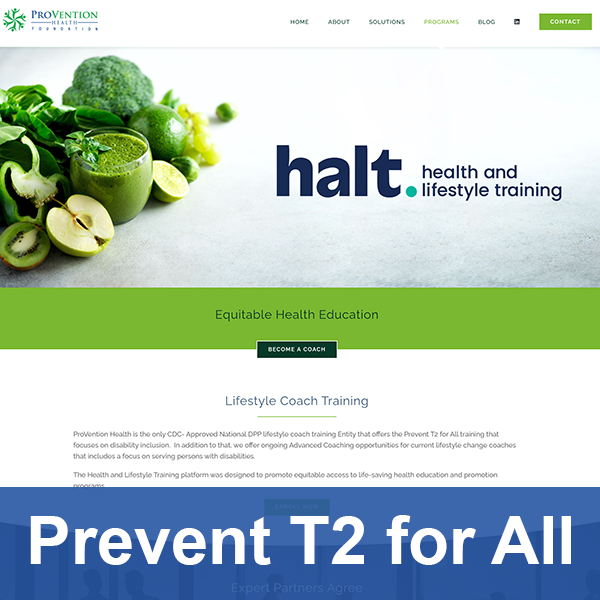
CDC-recognized organizations need to have National DPP Lifestyle Coaches with a basic understanding of principles, tips, and techniques for including people with disabilities in the National DPP lifestyle change program. The ProVention Health Foundation offers Prevent T2 for All, a CDC-approved training taught by an experienced National DPP Master Trainer, that includes information on effective communication and recruitment techniques, basic rules for adapting physical activity and nutrition basics for participants with disabilities, and suggested resources to allow for participation by all individuals. A list of examples relevant to the National DPP lifestyle change program are available in the Prevent T2 for All Nutrition and Physical Activity Toolkit. This list of adapted equipment focuses mainly on food preparation and cooking as well as physical activity. Existing Lifestyle Coaches who are interested in learning more about including people with disabilities in the National DPP lifestyle change program are also encouraged to contact the Lakeshore Foundation.
Stage 2: Partner
Identifying and leveraging partnerships with the disability community and those who serve them, such as cross-disability or condition-specific organizations, are critical to operationalizing programs that include people with disabilities. There are also state and local disability agencies, special recreation or educational personnel, or other health professionals, that may serve as valuable partners in this work. Above all, gaining the perspective of people with a wide range of disabilities is essential to ensuring successful program delivery.
The National DPP Call to Action Toolkit was created by NACDD in partnership with NCHPAD and the National Recreation and Park Association to support organizations in conducting outreach to partners within the disability community and provides state-specific information on partnerships within each state.
Stage 3: Assess
Stage 3 is to assess CDC-recognized organizations using the Guidelines, Recommendations, Adaptations, Including Disability or GRAIDS domains. Understanding how to assess a CDC-recognized organization for including people with disabilities is a critical, on-going effort.
The Community Health Inclusion Index (CHII), developed by NCHPAD, can help organizations understand the capacity of their site/organization and community to address the health needs of people with disabilities. Of note, the CHII does not assess compliance with any specific requirements and is only a measure of the level of an organization’s ability to include people with disabilities in the programs they offer.
Stage 4: Recruit
Stage 4 is to recruit people with disabilities. A resource related to this step is the Push for Your Health Campaign. This campaign was created by the Lakeshore Foundation and is designed to help CDC-recognized organizations recruit people with disabilities into their program. It includes evergreen videos, social media graphics, posters and more. NACDD and CDC has also developed the Keys to Success: How to Enroll and Retain People With Disabilities for Your Type 2 Diabetes Prevention Lifestyle Change Program. NCPHAD has also developed an informational video on How to Recruit People with Disabilities for Health Programs.
Stage 5: Recruit
Stage 5 is to sustain. State health departments and partners are encouraged to support including people with disabilities in the National DPP lifestyle change program and other chronic disease prevention programs. The Community Health Inclusion Sustainability Planning Guide or CHISP can help community health coalitions and initiatives understand how to keep a focus on including people with disabilities in their efforts to operationalize the National DPP lifestyle change program and other programs.
Additional Resources to Support Including People with Disabilities in the National DPP Lifestyle Change Program
For additional information and resources related to including people with disabilities, visit the following websites:
- The Lakeshore Foundation: a nonprofit, accessible fitness center and Paralympic and Olympic training center that served as a CDC funded DP17-1705 national partner organization. Lakeshore provides opportunities for people with a physical disability or chronic health condition to be active through physical activity, research, advocacy, and policy.
- NCHPAD: a CDC-funded public health practice and resource center on health promotion for people with disabilities. NCHPAD seeks to support people with disabilities and chronic conditions through increased participation in all types of physical, wellness, and social activities.
- The Retention page of the Coverage Toolkit details program adjustments made by partners in Montana to include people with disabilities in the program, including training Lifestyle Coaches on disabilities, simplifying language in participant materials and resources, and engaging family and support-systems in National DPP lifestyle change program efforts.
Creating Programs That Include People with Disabilities: 1705 National Organization Work
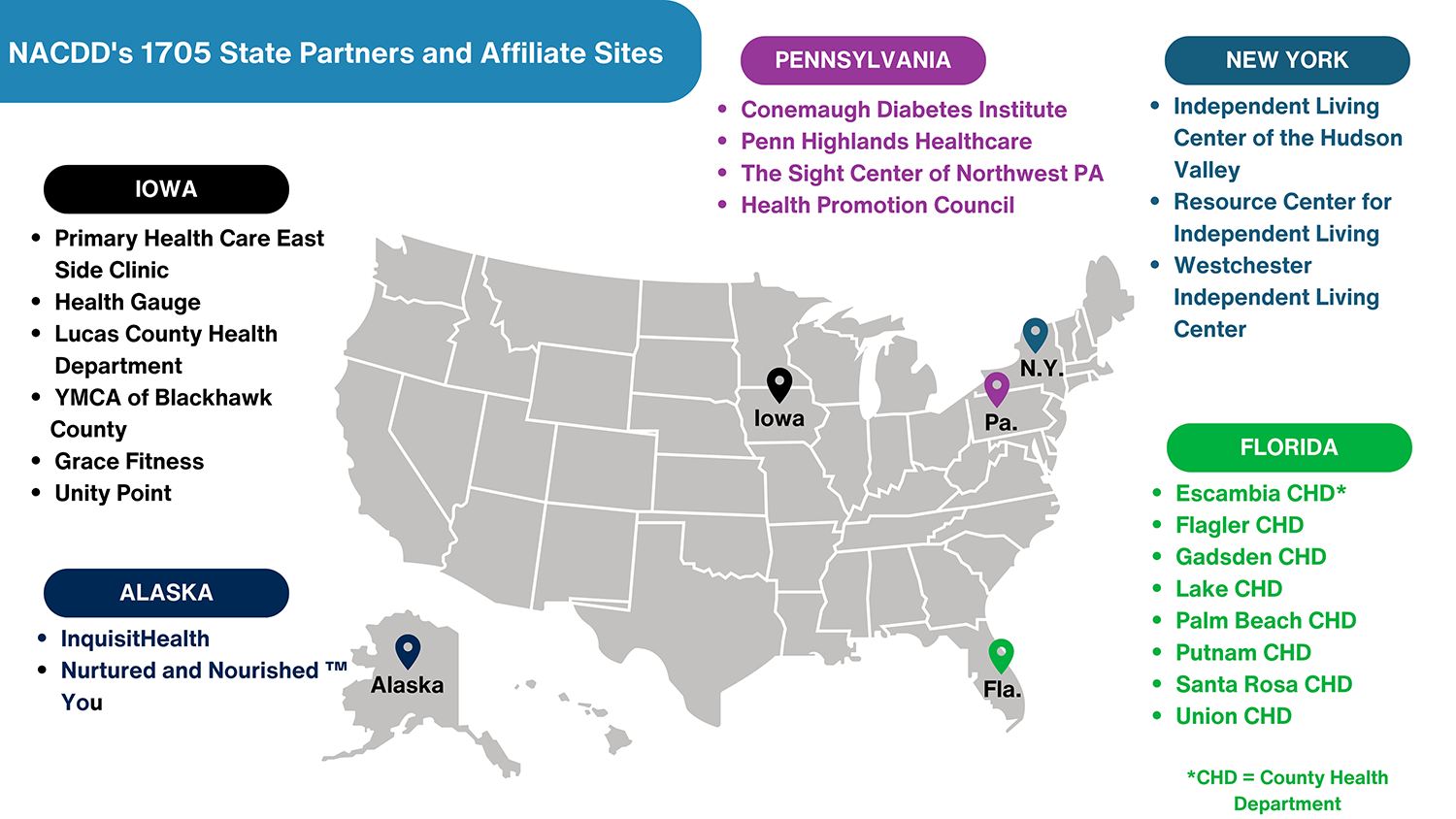
From 2017-2022, NACDD was funded as a recipient of CDC’s DP17-705 cooperative agreement to reach people with disabilities with the National DPP lifestyle change program. NACDD’s national partners in this work included the Lakeshore Foundation, ProVention Health Foundation, InquisitHealth, Virgin Pulse/Welltok, PAC Software, and Hope 80/20. State partners included the Alaska Department of Health and Social Services, Iowa Community Hub, Florida Department of Health, New York Association of Independent Living, and Health Promotion Council (PA). Additional state partners and affiliate sites are listed in the map below.
In addition to creating programs that included people with disabilities, the objectives of the project included:
- Increase the number of new CDC-recognized organizations that offer the National DPP lifestyle change program
- Increase referrals for the National DPP lifestyle change program by working with health system partners
- Market the National DPP lifestyle change program to drive enrollment
- Retain participants in the National DPP lifestyle change program
- Reimburse for delivery of the National DPP lifestyle change program through public and private payers and employers, and support Medicare Diabetes Prevention Program (MDPP) suppliers
NACDD’s examples of partnership initiatives that took place during the project are provided in the table below.
Technical Assistance Grants
NACDD, in partnership with the Lakeshore Foundation, offered technical assistance to support sustainability through mini-grants. These grants (available only during the DP17-1705 grant cycle) aimed to increase DP17-1705 state affiliate capacity to ensure people with physical and/or sensory disabilities had access to and were included in National DPP lifestyle change programs. Conemaugh Health (PA), Palm Beach County Health Department (FL), and CHP Community (IA) received these grants to purchase, store, and distribute wheelchair-accessible scales, develop an equipment resource catalog, and foster partnerships with local rehabilitation providers and Arc chapters (community-based organizations advocating for and with people with intellectual and developmental disabilities and serving them and their families) to recruit and enroll people with disabilities.
Documenting Program Success
NACDD partnered with the Alaska Department of Health and InquisitHealth to capture a success story video of an InquistHealth telephonic National DPP lifestyle change program participant from rural Alaska. The participant was referred to the program by their health care provider after experiencing two heart attacks and receiving bloodwork results in the prediabetes range. Through participating in the program, the individual lost almost 60 pounds and can now enjoy activities with less stress and fatigue. The success story was utilized by the Alaska Department of Health in their Fresh Start campaign.
Online Delivery
NACDD partnered with the ProVention Health Foundation to offer the Health and Lifestyle Training (HALT) diabetes software platform that enables any CDC-recognized organization to offer the National DPP lifestyle change program online. The HALT platform empowers CDC-recognized organizations to expand network capacity and affordable access to the National DPP lifestyle change program. NACDD provided users with onboarding training, recruitment and enrollment support, and customized marketing materials. Throughout the project, NACDD trained and onboarded 14 CDC-recognized organizations onto the HALT platform resulting in the enrollment of 245 participants.
Outcomes
Through the work on the DP17-1705 project, NACDD and partners:
- Worked across five states to support 31 programs in applying for and becoming CDC-recognized to offer the National DPP lifestyle change program.
- Supported four sites in becoming MDPP providers and four sites in becoming Medicaid providers.
- Supported the enrollment of over 1,400 participants with prediabetes into the National DPP lifestyle change program. Twelve percent of participants reported having a disability and achieved an average weight loss of 9.7%, compared to the national average of 5.2%.
- Trained and onboarded 12 CDC-recognized organizations onto the HALT platform, resulting in 10 cohorts with 140 participants.
- Provided at least 10 Lifestyle Coach trainings to 50+ Lifestyle Coaches, with a focus on including people with disabilities.
- Annually provided training, technical assistance, and one-on-one support to the five states and 20+ CDC-recognized organizations to successfully implement work plans addressing the five program objectives listed above, with a focus on including people with disabilities.
- Created multiple resources and toolkits for states and CDC-recognized organizations to use in reaching and enrolling people with disabilities into the National DPP lifestyle change program (training, intake form, and data collection support; marketing materials; and partnership engagement tools).