






Evidence-Based Programs → Food is Medicine
Food is Medicine
Food is Medicine (FIM) initiatives offer a promising strategy to prevent and manage diet-related chronic diseases, including type 2 diabetes. These approaches connect people to nutritious foods that support the management of diet-related conditions. For state health departments working to increase enrollment and retention in the National Diabetes Prevention Program (National DPP) lifestyle change program, FIM initiatives can be a powerful and cost-effective complement to improve participant engagement and health outcomes.
This page provides an overview of FIM interventions, highlights their connection to the National DPP lifestyle change program and diabetes self-management education and support (DSMES) services, and presents examples of how these approaches are being implemented. The page is organized into the following sections:
- Definition and Overview
- Linking the National DPP Lifestyle Change Program to Food is Medicine Interventions
- Payment Options for Food is Medicine Interventions
- State Examples of Food is Medicine Interventions
- Resources
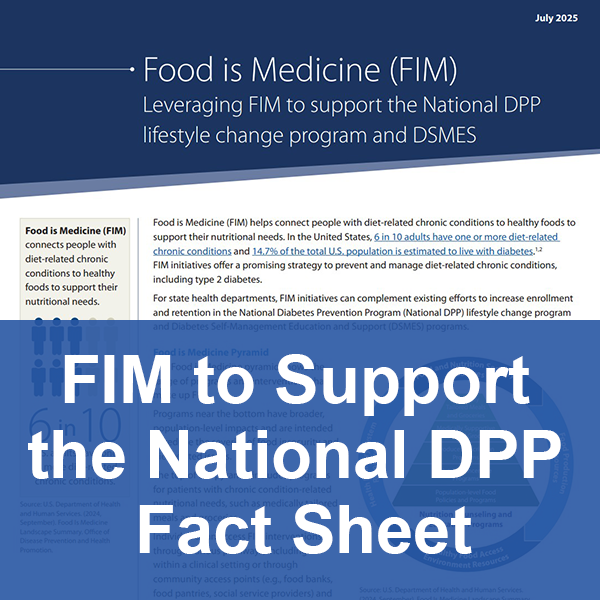
See the Leveraging FIM to Support the National DPP Lifestyle Change Program and DSMES Fact Sheet for a summary of this page’s content.
Definition and Overview
The U.S. Department of Health and Human Services (HHS) Office of Disease Prevention and Health Promotion describes FIM interventions as “encompassing a broad range of approaches that promote optimal health and reduce disease burden by providing nutritious food – with human services, education, and policy change, through collaboration at the nexus of health care and community.”
FIM interventions are an increasingly important component of federal and state strategies to address increasing rates of diet-related chronic conditions. They build on existing nutrition programs, such as the Supplemental Nutritional Assistance Program (SNAP), and complement population-level policies and programs by integrating access to nutritious food into clinical care and treatment plans. These interventions range from medically tailored meals and groceries, to offering fruit and vegetable prescriptions, to nutrition education.
FIM services typically require referrals from health and social care providers, enabling direct connections to community-based organizations and, in many cases, supporting closed-loop referral systems that facilitate two-way communication. These programs are designed to ensure that individuals with, or at risk for, chronic conditions can access the specific foods needed to support their health.
HHS has also developed a framework that illustrates the spectrum of FIM interventions. Programs at the base of the pyramid have broader, population-level impact, helping to reduce food insecurity and diet-related risks. At the top are more intensive, targeted interventions for individuals with the greatest need, such as medically tailored meals and groceries.
FIM interventions can be accessed through multiple pathways, including clinical settings, community-based organizations (e.g., food banks and pantries and social service providers), and state-administered assistance programs. In addition to health benefits, FIM initiatives may also generate economic value by supporting local food systems through the purchase of locally sourced foods.
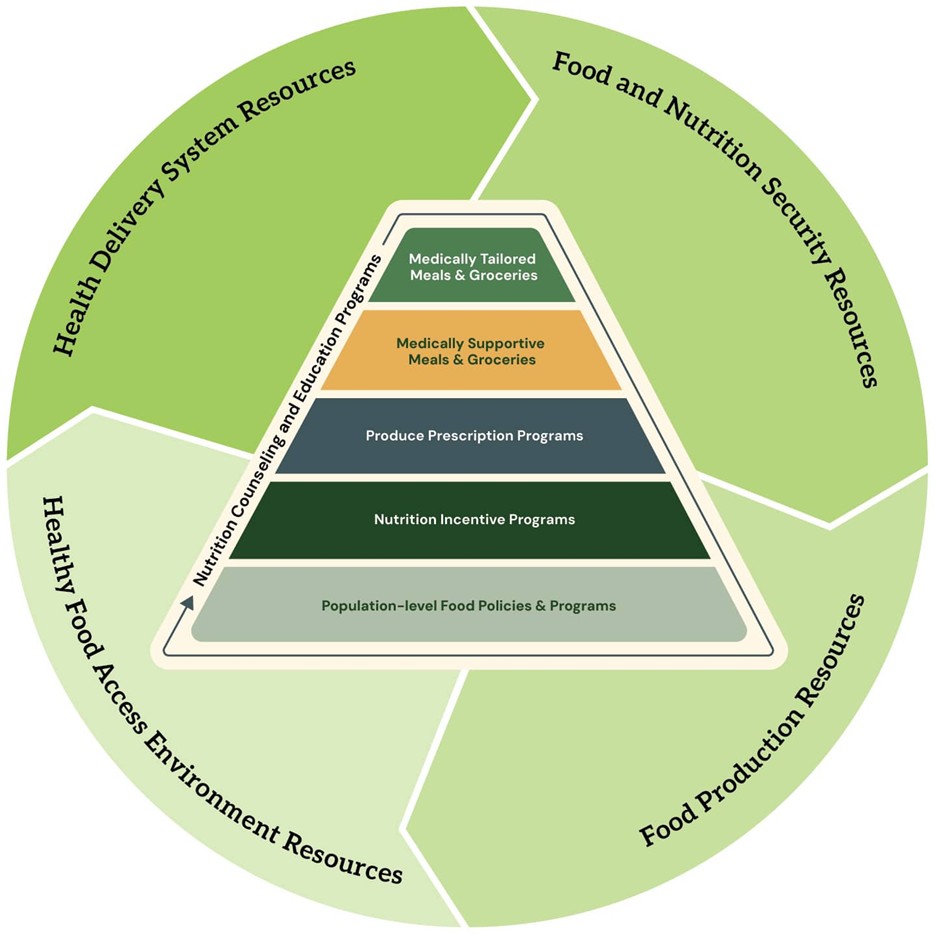
The programs at the top of the FIM pyramid are primarily clinical, designed to support patients’ food-related medical needs as part of a treatment plan. These services may be tailored to align with and honor cultural preferences, traditions, and dietary patterns, helping to improve patient satisfaction and engagement.
Common FIM interventions include:
- Medically tailored meals – Meals tailored to a patient’s medical condition.
- Medically tailored groceries – Grocery boxes designed by a registered dietitian to address a patient’s specific dietary needs and health conditions.
- Produce prescriptions – Free or discounted produce provided to ambulatory patients who meet specific eligibility criteria, such as having a chronic condition, like diabetes, prediabetes, hypertension, obesity or heart disease, as well as people with low incomes or experiencing food insecurity.
Linking the National DPP Lifestyle Change Program to Food is Medicine Interventions
FIM initiatives can connect eligible individuals to the National DPP lifestyle change program and serve as a program support to help with participant enrollment, retention, and improved health outcomes. State health departments and their partners can align FIM strategies with the program in the following ways:
- Identify and enroll: Use FIM programs as a referral source for the program. Individuals receiving medically tailored groceries or produce prescriptions may be more likely to meet National DPP lifestyle change program or DSMES eligibility criteria.
- Retention and support: Program participants may be more likely to stay engaged when FIM resources support their dietary changes. Lifestyle Coaches could help program participants identify local FIM resources and encourage them to seek referrals from their health care provider.
- Enhance clinical referrals: Embed FIM and National DPP lifestyle change program referrals in electronic health records and provider workflows. This integration can streamline the referral process and increase the likelihood that eligible patients are connected to both nutrition support and evidence-based programs.
Leveraging State and National Health Initiatives
The National Strategy on Hunger, Nutrition, and Health (2022-2025) emphasized the importance of strengthening prevention and management of type 2 diabetes and outlined several strategies to support state and local efforts. One key strategy was expanding access to FIM interventions for Medicaid and Medicare beneficiaries.
The strategy highlighted the use of legislation and 1115 waivers to support pilot demonstrations testing expanded Medicaid coverage for nutrition-related services. As of March 2026, fifteen states have approved or pending 1115 waivers that include nutrition supports, with states like California and Oregon approved to test medically tailored food assistance initiatives.
Similar nutrition-focused program supports have also been implemented in states such as Minnesota, Mississippi, and Virginia for Medicaid beneficiaries enrolled in the National DPP lifestyle change program.
Payment Options for Food is Medicine Interventions
As awareness and interest continue to grow nationwide, states are exploring payment options for food and nutrition-related supports, including FIM interventions. The following are potential payment options for FIM interventions, many of which align with those used for the National DPP lifestyle change program and DSMES services.
- Section 1115 demonstration waivers: Once approved by the Centers for Medicare and Medicaid Services (CMS), these waivers allow states to pilot new approaches to deliver Medicaid benefits. For more information on HRSN and 1115 waivers, see the Attaining Coverage through a Section 1115 Demonstration Waiver page.
- Section 1915 Home and Community-Based Services (HCBS) waivers: States may include nutrition supports in HCBS waivers for specific populations. These waivers are intended to fund programs to allow certain beneficiaries to receive services in their home or community, rather than in an institutional or clinical setting. HCBS waivers include the following:
- In lieu of services and settings (ILOS) under managed care: Under ILOS authority, Medicaid managed care plans can offer FIM services as substitutes for standard Medicaid services. ILOS must be cost-effective and medically appropriate. See how Michigan is covering nutrition services via Medicaid and ILOS.
- Value-added services: In addition to ILOS, managed care organizations (MCOs) or other like-entities can offer additional services beyond those included in state Medicaid contracts. These “value-added services” provide another potential pathway to integrate FIM into Medicaid managed care. Through this approach, MCOs can voluntarily offer FIM services that are not otherwise included in state Medicaid benefits.
- Medicare Advantage (MA): MA plans may cover FIM meals or food and produce. Some of these supplemental benefits are only available to eligible MA plan enrollees who are chronically ill (Special Supplemental Benefits for the Chronically Ill [SSBCI]).
Researchers from Tufts University and the University of Massachusetts developed a state-level simulation model estimating that coverage of medically tailored meals through Medicare, Medicaid, and private insurance for individuals with diet-sensitive conditions and limitations in activities of daily living could reduce hospitalizations nationwide and generate net cost savings in 49 states.
The Medicaid Food Security Network has also developed a guide and accompanying tools for Calculating the Cost of Medicaid Food is Medicine Interventions. The resource includes step-by-step guidance and a spreadsheet calculator to estimate a FIM program’s impact on Medicaid capitation rates while covering cost assumptions, including costs, return on investment (ROI) considerations, and how to test the cost limits of proposed FIM programs.
For additional guidance, see:
- HHS: Select Policy Pathways for Food is Medicine Interventions
- Food is Medicine: A State Medicaid Policy Toolkit (2024)
- CMS Addressing Health-Related Social Needs in Section 1115 Demonstrations (2022)
- Resource Guide – Partnerships with Community-based Organizations: Opportunities for Health Plans to Create Value
State Examples of Food is Medicine Interventions
The tabbed table below explores examples of states that have integrated FIM interventions into their Medicaid programs.
Alaska
Alaska has explored opportunities to integrate FIM interventions into Medicaid through Section 1115 waiver planning and policy development efforts in partnership with the Center for Health Law and Policy Innovation (CHLPI). The state’s work highlights how rural and frontier states are considering nutrition supports as part of broader strategies to address chronic disease, food insecurity, and health equity.
California
California’s Advancing and Innovating Medi-Cal (CalAIM) is a statewide effort to transform the state’s Medicaid program. A key component, CalAIM Community Supports, is designed to “improve the overall health and well-being of Medi-Cal managed care plan (MCP) members by addressing members’ health-related social needs, help them live healthier lives, and avoid higher, costlier levels of care.” These supports include optional services that health plans can opt to provide in lieu of high-cost services traditionally covered by Medi-Cal. In addition to services such as housing transition and navigation, housing deposits, personal care and homemaker services, and day habilitation programs, Medi-Cal also offers medically supportive food and medically tailored meals to eligible members.
Medi-Cal Managed Care Plans (MCPs) are encouraged to offer a range of food and nutrition supports to address poor health outcomes associated with food insecurity, support complex care needs, meet specialized dietary requirements, manage chronic conditions, and reduce hospitalizations.
Services offered under this support include:
- Home-delivered meals following hospitalization that meet specific dietary needs
- Support from a registered dietician or other qualified professional
- Delivery of medically tailored groceries
- Healthy food vouchers
- Food pharmacies
- Nutrition, cooking, and behavioral education
A pilot program supported by California’s Department of Health Care Services (DHCS), Project Angel Food, and Anthem helped inform the inclusion of medically supported meals as a CalAIM Community Support. The pilot included 252 patients with conditions such as gestational diabetes, chronic heart failure, end-stage renal disease, and hypertension across Los Angeles, San Francisco, and Santa Clara Counties.
Participants received 14 medically tailored meals per week for 13 weeks, along with three nutritional counseling sessions. By the end of the pilot program, 35% of participants reported improved quality of life, 87% reported maintaining or reducing hospitalizations, and 83% reported maintaining or improving medication adherence.
Hawaii
Hawaii’s Medicaid and FIM efforts are notable for explicitly supporting local food procurement and culturally relevant nutrition interventions. The state’s approach aligns nutrition assistance strategies with broader goals related to food sovereignty, local agriculture, and community resilience.
Massachusetts
Massachusetts’ 1115 demonstration waiver, effective October 2022, allows the state to pilot benefits such as time-limited housing supports, clinical nutrition education, and medically tailored food assistance. The waiver enables the state to receive federal Medicaid matching funds for specified demonstration expenditures.
While Massachusetts currently does not have Medicaid coverage of the National DPP lifestyle change program, these services illustrate how nutrition and social supports can complement and strengthen program participation.
As noted in the original demonstration approval, “services authorized…to address health-related social needs (HRSN) must be medically appropriate for the beneficiary.… The time-limited housing and nutritional support services…can be expected to stabilize the housing and nutritional circumstances of certain eligible Medicaid enrollees and thus increase the likelihood that they will keep receiving and benefiting from the Medicaid-covered services.”
CMS also authorized Massachusetts to provide case management, outreach, and education, along with infrastructure investments and transportation services to support health equity initiatives.
From 2020 to 2022, Massachusetts’ Medicaid pilot providing nutrition supports was associated with fewer hospitalizations and emergency department visits, and, for some adult participants, lower health care costs.
For additional information on 1115 waivers as they relate to coverage for the National DPP lifestyle change program, please visit Attaining Coverage Through a Section 1115 Demonstration Waiver page of the Coverage Toolkit.
North Carolina
North Carolina’s Healthy Opportunities Pilots (HOP), previously authorized through the state’s 1115 waiver, provided evidence-informed nutrition and social support services for eligible Medicaid beneficiaries. Nutrition-related services included:
- Produce prescriptions
- Healthy food boxes
- Medically tailored meals
- Medically tailored groceries
The pilot was designed to address social drivers of health while evaluating impacts on health outcomes, health care utilization, and costs.
Oklahoma
Oklahoma enacted Senate Bill 806 in 2025, establishing one of the nation’s first statewide FIM initiatives in statute. The legislation supports collaboration among state agencies, health care providers, community organizations, and food system partners to advance medically supportive nutrition interventions. Oklahoma’s approach demonstrates growing bipartisan interest in formalizing FIM strategies through state legislation in addition to Medicaid waivers and pilot programs.
Oregon
Oregon’s 1115 demonstration waiver, effective October 2022, expands opportunities to provide food and housing supports to Medicaid beneficiaries. Under the waiver, allowable nutrition-related services include:
- Nutrition counseling and education, including healthy meal preparation
- Medically tailored meals (up to three meals per day for up to six months)
- Meal delivery or pantry stocking (up to three meals per day for up to six months)
- Fruit and vegetable prescriptions (up to six months)
The waiver also allows Oregon to claim federal Medicaid matching funds for infrastructure investments to support the development and implementation of these HRSN services. Through the waiver, additional federal funding is also available for technology, operational improvements, workforce development, outreach, education, and stakeholder engagement.
Oregon has covered the National DPP lifestyle change program since January 2019 under a prior 1115 waiver, and coverage continues under the current waiver as well as a state plan amendment. As a result, the expanded food and housing supports may complement and enhance participation for individuals enrolled in the National DPP lifestyle change program. For additional information on how Oregon’s 1115 waiver was used to achieve coverage of the National DPP lifestyle change program, please visit Attaining Coverage Through a Section 1115 Demonstration Waiver page of the Coverage Toolkit.
Food is Medicine Resources
- Leveraging Food is Medicine to Support the National DPP Lifestyle Change Program and DSMES Fact Sheet
- A Systematic Review of “Food is Medicine” Randomized Controlled Trials for Noncommunicable Disease in the United States (American Heart Association, 2025)
- Estimated Impact of Medically Tailored Meals on Health Care Use and Expenditures in 50 U.S. States (Health Affairs, 2025)
- Understanding Food is Medicine (U.S. DHHS)
- National Strategy on Hunger, Nutrition, and Health (2022)
- Food is Medicine Landscape Summary (U.S. DHHS)
- Calculating the Cost of Medicaid Food is Medicine Interventions (Medicaid Food Security Network (2026)
- HHS: Select Policy Pathways for Food is Medicine Interventions
- Food is Medicine: A State Medicaid Policy Toolkit (2024)
- Resource Guide – Partnerships with Community-based Organizations: Opportunities for Health Plans to Create Value