






Medicare → MDPP Basics
Medicare Diabetes Prevention Program (MDPP) Basics
The Center for Medicare and Medicaid Innovation Medicare Diabetes Prevention Program (MDPP) site is the primary source for information and resources regarding the MDPP. This page provides a brief overview of the MDPP, including the following topics:
- MDPP Overview
- MDPP Services
- Beneficiary Eligibility Criteria and Referrals
- MDPP Supplier Eligibility and Enrollment
- Payment for MDPP Services
- Beneficiary Engagement Incentives
- Medicare Advantage Plans and the MDPP
MDPP Overview
The MDPP expanded model allows Medicare beneficiaries to access evidence-based diabetes prevention services with the goal of a lower rate of progression to type 2 diabetes, improved health, and reduced spending. On March 23, 2016, the Department of Health and Human Services (HHS) announced that the Centers for Medicare and Medicaid Services (CMS) Office of the Actuary (OACT) certified that the National DPP lifestyle change program would “reduce net-Medicare spending.” MDPP suppliers began enrolling in Medicare on January 1, 2018, and began furnishing MDPP services and billing Medicare for MDPP services on April 1, 2018.
Medicare Advantage plans are also required to offer the benefit to their members. To learn more please see the Medicare Advantage Plans and the MDPP section below.
Some key differences between the CDC recognition requirements and the MDPP benefit should be noted, including:
- Age of beneficiaries (limited to those enrolled in Medicare Part B)
- CDC-recognized organization eligibility criteria versus MDPP supplier organization eligibility criteria
CMS has provided an interactive map showing MDPP suppliers in the United States. Use the map to help find MDPP suppliers in your area.
A list of frequently asked questions about the MDPP and answers from CMS can be found here.
Medicare DPP Promotional Materials for Part B Beneficiaries with resources specific to promoting the Medicare DPP to Medicare Part B beneficiaries and their health care providers that CDC has developed are available here.
Please note that Medicare is a government-sponsored health insurance plan for people aged 65 or older. Medicare has various parts, and the Medicare 101 & MDPP document outlines the distinct parts of Medicare, what services they cover, the associated member cost sharing, and where the MDPP fits in.
A 2025 MDPP Final Evaluation Report prepared by RTI International and Amico Consulting presents promising findings related to MDPP supplier enrollment, beneficiary engagement and participation, short-term health outcomes, and long-term health outcomes. Review a summary of these findings in the image below.
MDPP Final Evaluation Report: Summary of Results
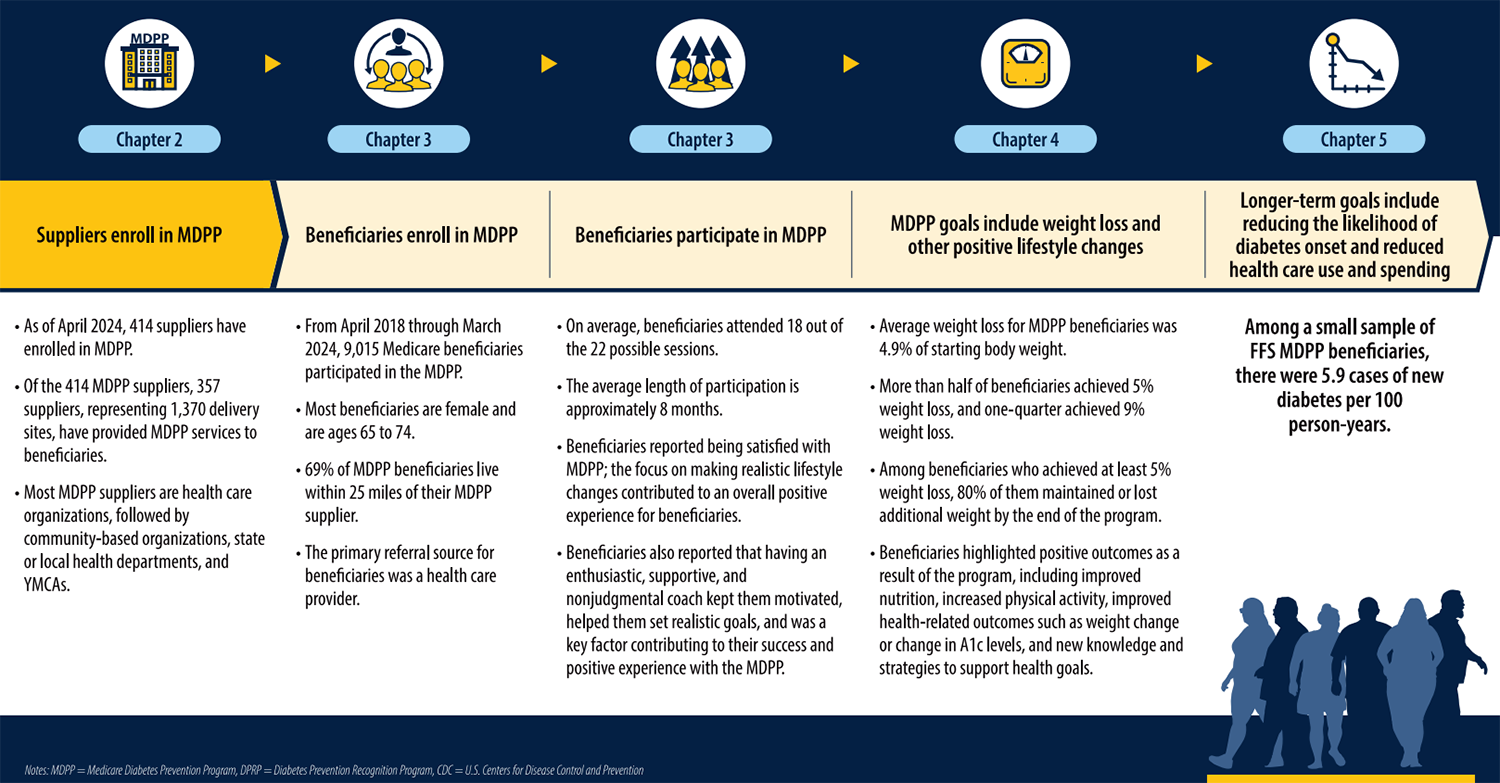
*Source: MDPP Final Evaluation Report
MDPP Services
- The MDPP is covered under Medicare Part B as a preventive service.
- For the period beginning January 1, 2026 and ending December 31, 2029, there is no limit applied on the number of times an individual may enroll in the MDPP, as established in H.R. 7148 Section 6214.
- Medicare cost sharing does not apply to MDPP services.
- Benefit description:
- Core services period is 12 months: 16 weekly core sessions over months 1-6, and 6 monthly core maintenance sessions in months 7-12
- Sessions are approximately one hour each
- No minimum or maximum number of beneficiaries per session
- Limited in-person and/or remote makeup sessions may be provided
- Organizations must apply for and receive MDPP supplier status prior to receiving reimbursement for MDPP services. Organizations seeking to become an MDPP supplier must currently have CDC preliminary, full, or full plus recognition prior to applying.
- MDPP suppliers may use any CDC-approved lifestyle change program curriculum.
- MDPP services may be delivered by CDC-recognized organizations that have a online, in-person, or in-person with a distance learning component organization code. For more information, see CDC’s Diabetes Prevention and Recognition Program (DPRP Standards and CMS’ latest guidance on distance learning).
- H.R. 7148 Section 6214 allows for asynchronous, online delivery of the MDPP for the period beginning January 1, 2026 through December 31, 2029. CMS has stated, “The inclusion of the online, asynchronous delivery modality is considered a test…to determine if evaluation results, including weight loss, are similar to In-person and distance learning delivery modalities.” As such, synchronous and asynchronous modalities may not be combined and must remain mutually exclusive for individual beneficiaries.
Beneficiary Eligibility Criteria & Referrals
- Eligibility criteria:
- Are enrolled in Medicare Part B (for more information see CMS’s How to Verify an MDPP Beneficiary’s Medicare Coverage document);
- BMI ≥ 25; ≥ 23 if self-identified as Asian;
- A1c (HgA1c) between 5.7 and 6.4%, or a Fasting Plasma Glucose (FPG) test result of 110-125 mg/dL, or a 2-hour Post-Glucose Challenge Test result of 140-199 mg/dL (oral glucose tolerance test) within the previous 12 months;
- Have no previous diagnosis of type 1 or type 2 diabetes with the exception of a previous diagnosis of gestational diabetes; and
- Does not have end-stage renal disease (ESRD) at any point during the MDPP services period.
- Beginning in January 1, 2026 and ending December 31, 2029, there is no limit applied on the number of times an individual may enroll in the MDPP , as established in H.R. 7148 Section 6124.
- Although referrals are not required, the following referrals are allowed, as long as blood test results indicate eligibility:
- Self-referral from participant
- Community referral
- Physician referral
- Other health care practitioner referral
Previously, the FPG test and the Post-Glucose Challenge Test were the only diabetes screening tests covered by Medicare, but under the CY 2024 Physician Fee Schedule (see section L), the HbA1c test is now also covered. All three of the diabetes screening tests are covered twice within the 12-month period following the date of the most recent diabetes screening test of an individual.
MDPP Supplier Eligibility & Enrollment
MDPP suppliers must 1) enroll under Medicare; and 2) have CDC preliminary, full, or full plus recognition. For more information on the various levels of CDC recognition see CDC’s Diabetes Prevention Recognition Program (DPRP) standards.
- MDPP suppliers must also maintain at least one administrative location—a non-private residence—and a primary business telephone number.
- All “lifestyle coaches” (who are employed by an MDPP supplier) must obtain an NPI, which will be reported with Medicare claims:
- To be eligible to provide MDPP services, coaches may not have had Medicare billing privileges revoked or have been convicted of a felony within the last 10 years.
- Individual coaches cannot apply to be an MDPP supplier.
- Individual coaches should be compliant with the CDC Recognition Standards coach requirements.
- All CDC-recognized organizations must enroll in Medicare as MDPP suppliers to furnish and bill for MDPP services.
- Existing Medicare suppliers must enroll as MDPP suppliers to offer the program.
- If an MDPP supplier’s Medicaid billing privileges are revoked, Medicare billing privileges will also be revoked.
- MDPP suppliers must submit a roster of coach NPIs, names, and social security numbers upon application for enrollment.
- MDPP supplier enrollment began January 1, 2018.
More CMS resources for MDPP Supplier enrollment, located on the Center for Medicare and Medicaid Innovation MDPP site, include:
- MDPP Supplier Roadmap (Overview of the MDPP Supplier Journey)
- MDPP Enrollment (How to Prepare for Enrollment)
- CMS/CDC Roles Fact Sheet (Outlines Roles of CMS/CDC)
MDPP Orientation Video: Provides an overview of the MDPP for organizations interested in becoming suppliers.
Payment for MDPP Services
MDPP services are paid for using both a fee-for-service and performance-based payment methodology that is updated annually for inflation. Fee-for-service payments are issued for beneficiary attendance and performance-based payments are given based on beneficiary weight loss.
The following table details the CMS Calendar Year MDPP Payment Rates and the maximum reimbursement available per beneficiary:
| HCPCS G-Code | Payment Description | Payment |
|---|---|---|
| G9871 | Behavioral counseling for diabetes prevention, online, group, 60 minutes | $18 |
| G9886* | Behavioral counseling for diabetes prevention, in-person, group, 60 minutes | $27 |
| G9887* | Behavioral counseling for diabetes prevention, distance learning, group, 60 minutes | $27 |
| Subtotal Maximum Attendance-Based Payment (22 in-person or distance learning sessions | $594 | |
| G9880 | 5 percent weight loss (WL) achieved from baseline weight | $153 |
| G9881 | 9 percent WL achieved from baseline weight | $27 |
| G9888** | Maintenance 5 percent WL from baseline in months 7-12 | $8 |
| Total Maximum Payment | $822 |
- *Medicare pays up to 22 sessions billed with codes G9886 and G9887, combined, in a 12-month period:
- Months 1-6: 1 in-person/distance learning or online session every week (max 16 sessions)
- Months 7-12: 1 in-person/distance learning or online session every month (max 6 sessions)
- ** Months 7-12, once participant achieves 5% WL, supplier may submit Maintenance of 5% WL claim with attendance claim (G9888 + G9886/G9887 or G9871). Medicare will pay for Maintenance 5% WL up to 6 times in months 7-12.
Note that the CPT Modifier 76 must be added to any claim for a make-up session that was held on the same day as a regularly scheduled MDPP session.
Beneficiary Engagement Incentives
- If an MDPP supplier offers an in-kind incentive, the item or service must be provided during the MDPP services period and must have a reasonable connection to the CDC-approved curriculum.
- Cost of incentives must not be shifted to another Federal health care program or to a beneficiary.
- MDPP suppliers must maintain documentation of incentives that individually exceed $25 in retail value; incentives involving technology may not, in aggregate, exceed $1,000 in retail value for any one MDPP beneficiary.
Medicare Advantage Plans and the MDPP
All Medicare beneficiaries have access to MDPP services. There are two ways in which Medicare beneficiaries can receive these benefits:
- Through original Medicare, which is comprised of Part A (hospital services) and Part B (outpatient medical services), or
- Through Medicare Part C, also known as Medicare Advantage.
Original Medicare is administered directly by the federal government, and beneficiaries may receive care from any provider that accepts Medicare. Medicare Advantage (MA) provides Medicare benefits through approved private insurance companies, rather than directly through the federal government, and generally receive care from a specific network of providers. MA plans must provide enrollees with all Medicare Part A and Part B services, but they may also cover additional benefits, such as dental or vision care.
CMS has released guidance for Medicare Advantage plans, including an MA Fact Sheet and document that contains Medicare Advantage-related extracts from the MDPP Calendar Year 2018 Physician Fee Schedule Final Rule. For more information, visit the CMS MDPP website or see CMS MDPP Expanded Model Fact Sheet.
In addition to these resources, CMS, the National Association of Chronic Disease Directors (NACDD), and Leavitt Partners worked collaboratively to host an informational webinar on how MDPP suppliers can work with MA plans. An accompanying resource was developed that details the information presented during the webinar.